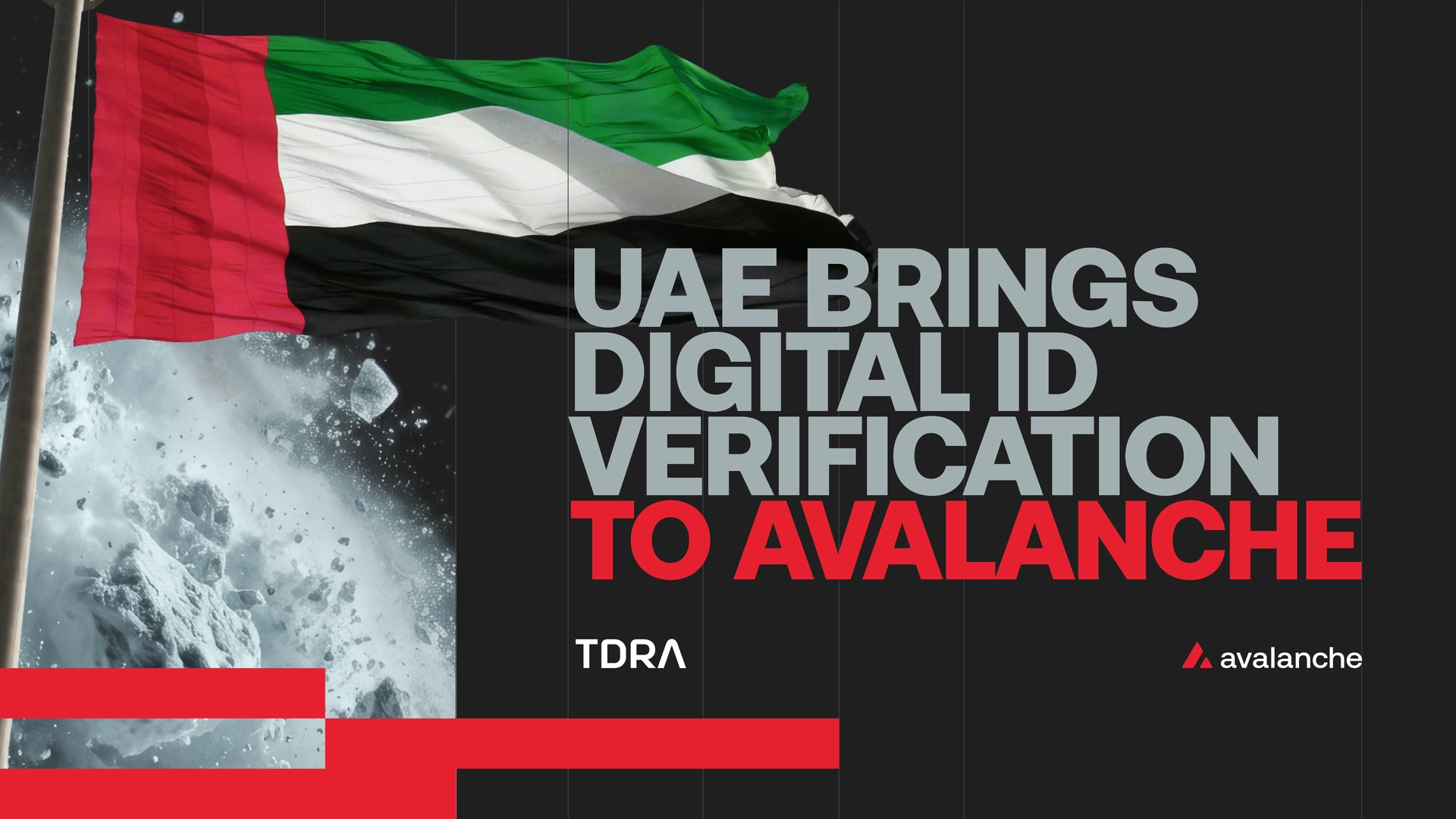
TDRA, the UAE's federal digital government authority, is moving the UAEPASS Digital Vault to Avalanche
Opening a bank account means proving an address and an identity. Registering a company means proving a trade license. Enrolling in a university means proving a degree. Activating a utility, applying for a visa, claiming a benefit, transferring a vehicle, each one requires a document that some institution issued and some other institution has to trust.
The traditional answer is paper, and paper does not scale. Documents get photocopied, notarized, couriered, re-submitted and verified again by every institution that needs them, each running its own check because it has no way to rely on anyone else's. For the individual this means the same proof assembled repeatedly. For the institution it means duplicated verification work on documents it cannot independently confirm are genuine.
The UAE’s Telecommunications and Digital Government Regulatory Authority (TDRA) took a different approach, and is upgrading its blockchain infrastructure underneath the UAEPASS Digital Vault to Avalanche.
What is UAEPASS
UAEPASS is the UAE's national digital identity platform. It is how citizens, residents and visitors authenticate themselves, sign documents and reach government and private-sector services online.
The numbers describe the scope better than any characterization does:
12.5 million citizens, residents and visitors use it
15,000+ services are accessible through it
350+ government and private-sector entities rely on it
Inside that platform sits the Digital Vault, the component that handles verified documents. It lets a person request a document, hold it, and share it with an institution that needs to see it. According to TDRA, the Telecommunications and Digital Government Regulatory Authority that oversees the platform, the Digital Vault is powered by blockchain to support the secure storage and sharing of those documents.
That blockchain layer is upgraded to Avalanche, to strengthen the scalability and performance needed to support continued growth in digital identity and verifiable documents across the country.
What trust at national scale requires
A document is only useful if the institution receiving it can trust it. That trust has to come from somewhere, and in a digital system it comes from the issuer. If a ministry issues a credential and a bank can confirm that ministry issued it, the bank does not need to run its own verification. The check becomes a lookup instead of an investigation.
Trust at national scale requires an issuer that every institution already accepts, a shared record that no single participant can quietly revise, and enough performance that verification resolves in the time a person is willing to wait at a counter or on a webpage. Remove any one of those and the system does not get adopted.
With 12.5 million users and 350 institutions attached, performance cannot vary by the hour, and the operator cannot be told by a third party that priorities have changed. The requirement is reliability, indefinitely, under someone else's growth curve.
Why a dedicated L1
The Digital Vault runs on an Avalanche L1, which means dedicated infrastructure rather than shared blockspace. For a system with millions of people using it, that distinction plays a huge part.
Capacity is not contended by unrelated activity elsewhere on a network. When someone at a bank counter shares a trade license, the verification does not queue behind traffic that has nothing to do with the UAE. Performance stays predictable rather than varying with conditions the operator does not control, which is the point of an upgrade whose stated purpose is to support continued growth in digital identity and verifiable documents across the country.
Network membership, permissioning and configuration remain decisions the operator makes rather than inherits. This is the part public institutions tend to weigh most heavily. TDRA holds oversight of the UAEPASS Digital Vault ecosystem, and that oversight only means something if the authority can set the terms of the infrastructure beneath it. A government cannot outsource accountability for a system 12.5 million people depend on.
A dedicated L1 makes that control structural rather than contractual. The operator sets the conditions it needs instead of relying on someone else to preserve them. For a platform the UAE expects to carry this responsibility for years, that is the difference between choosing a technology and choosing an infrastructure.
A similar pattern, different continent
The UAE is not the only public authority to arrive at this architecture.
The California DMV has digitized 42 million vehicle titles on a DMV-run Avalanche L1, cutting a title transfer that once took around two weeks down to minutes. The shape of the solution is the same. A public authority keeps control of its own chain and uses Avalanche for the layer underneath.
Two authorities on opposite sides of the world, one handling identity credentials and the other handling property titles, serving tens of millions of people each, converging on the same answer. That convergence is the more interesting data point than either deployment alone, because it suggests the requirements of public-sector record keeping push toward this architecture rather than any particular agency preferring it.
What reusable verification unlocks
Verifiable credentials have been discussed as a category for well over a decade. The obstacle was never cryptographic. It was institutional. Getting an organization to accept a verification it did not perform itself requires an issuer that organization already trusts, and very few things qualify.
A national identity platform is one of them. When a country operates the identity layer and both ministries and private companies already authenticate through it, the trusted issuer problem is solved before the technology question is even asked. That is why national identity systems, rather than consortium pilots, keep turning out to be where verifiable credentials actually get used.
What follows from that is a shift in where verification work happens. Instead of every institution verifying every document independently, verification happens once, at issuance, and everyone downstream relies on it. The document becomes portable. Onboarding that took days can resolve in minutes. The institution's compliance obligation is met with a stronger assurance than a photocopy ever provided.
Conclusion
Most discussion of blockchain in government stays theoretical, which makes the operating examples worth attention.
A federal regulator responsible for a platform 12.5 million people depend on evaluated infrastructure for a live, citizen-facing system and selected Avalanche. Public procurement is slow and heavily documented precisely because the consequences of getting it wrong are public. Infrastructure that comes through that process has been tested against a different standard than infrastructure chosen by a market.
For any government or institution weighing the same decision, the UAE is a reference point rather than a proposal. One identity layer, one place verification happens, 350 institutions relying on it. The measure of success is that none of the 12.5 million people using it ever has to think about any of it.UAE’s Identity System Serving 12 Million People Upgrades to Avalanche