Six research teams have been selected for funding through the Avalanche Foundation’s first Call for Research Proposals.
Today, the Avalanche Foundation is announcing the six research teams selected through its first Call for Research Proposals. Over the coming year, they will work on two of the most important open questions in blockchain economics: cryptoasset pricing and valuation, and validator economics and network security.
The Foundation’s own research into how value is measured, captured and distributed across a blockchain economy is already well underway. This program brings independent academic expertise to that work, to accelerate it and to produce findings that can directly inform how Avalanche is built and governed.
“Our research agenda already has real momentum, and this program is designed to accelerate it,” said Matias A., Chief Investment Officer at the Avalanche Foundation. “Bringing in researchers of this calibre means we can tackle the hardest open questions in blockchain economics faster. I’m looking forward to working with them, and to putting their findings to work on Avalanche.”
Selection Process
Selection Committee Image
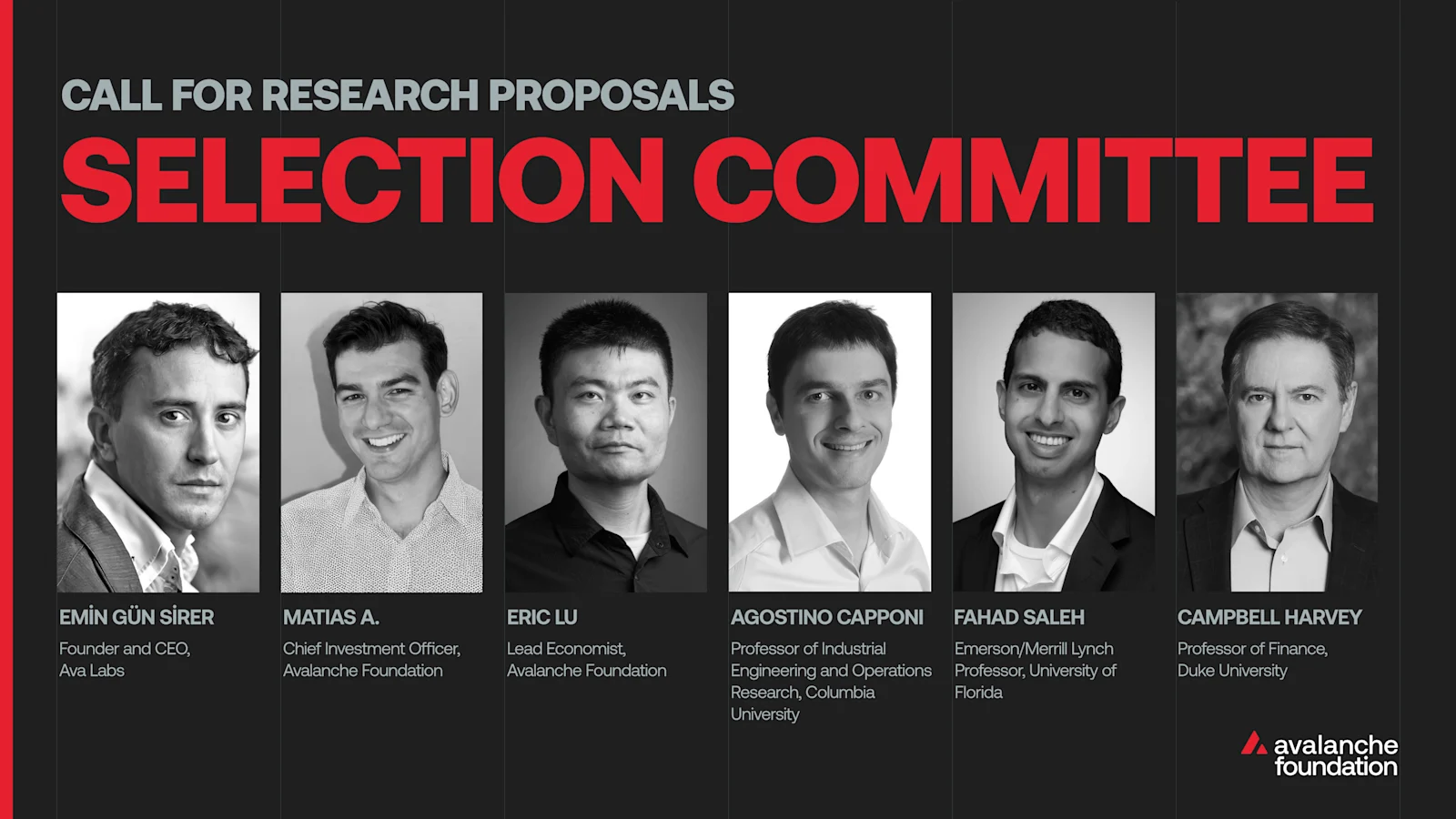
More than 175 proposals were submitted. Around 90 progressed to full committee review, and six have been selected for funding. Proposals were reviewed by a selection committee of Avalanche Foundation and Ava Labs leaders alongside independent academics in blockchain economics:
Emin Gün Sirer - Founder and CEO, Ava Labs
Matias A. - Chief Investment Officer, Avalanche Foundation
Eric Lu - Lead Economist, Avalanche Foundation
Campbell Harvey - Professor of Finance, Duke University, and Research Associate, National Bureau of Economic Research
Fahad Saleh - Emerson/Merrill Lynch Professor, University of Florida, and Cryptoeconomics Advisor, Columbia University CDFT
Agostino Capponi - Professor of Industrial Engineering and Operations Research, Columbia University, and Director, Center for Digital Finance and Technologies
Each committee member reviewed the pool independently, without coordinating with one another, and scored every submission on relevance, concreteness, novelty, method, actionability, feasibility and team strength. Where a committee member had a prior professional relationship with an applicant, they recused themselves from assessing that proposal.
This process is being published openly because research funding decisions should be able to withstand scrutiny. An independent, multi-reviewer process is how the Foundation intends to maintain that standard.
The Grantees and Selected Proposals
Selected Proposals Image
The teams bring together faculty and researchers from Stanford University, the University of Oxford, Imperial College London, Nanyang Technological University, HKUST (Guangzhou), Stevens Institute of Technology, Renmin University of China and the University of Saskatchewan. Between them, they hold doctorates from institutions including Stanford, MIT, Princeton, Duke and Columbia. Each proposal was selected for its potential to deliver practical, actionable findings.
Cryptoasset Pricing and Valuation
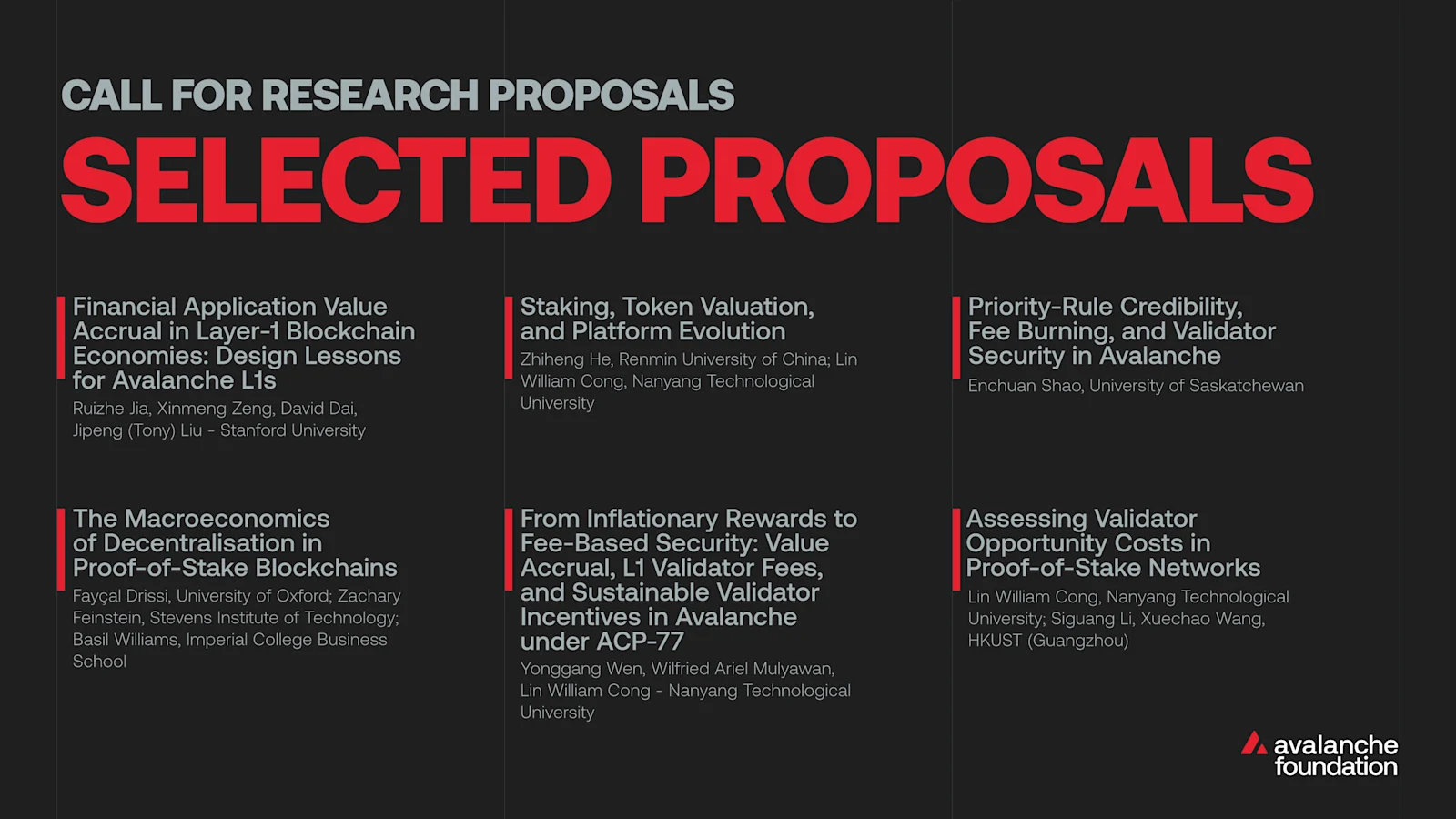
Financial Application Value Accrual in Layer-1 Blockchain Economies: Design Lessons for Avalanche L1s
Ruizhe Jia, Stanford University, with Xinmeng Zeng, David Dai and Jipeng (Tony) Liu
When a trading venue or lending market succeeds on a Layer 1, does that value reach the underlying chain? Led by Stanford Assistant Professor Ruizhe Jia, this project traces who pays trading and liquidation fees, and where those flows end up.
The committee noted that most research measures a blockchain by its own transaction fees, while this proposal treats application revenue as a core source of an ecosystem’s value, an important question that has not been studied carefully. Reviewers saw strong overlap with the Foundation’s research agenda, particularly in how value from applications is measured and captured.
Staking, Token Valuation, and Platform Evolution
Lin William Cong, Nanyang Technological University, with Zhiheng He, Renmin University of China
This proposal examines how staking should be built into token valuation, modeling it as a feedback loop between liquidity, network security and platform productivity.
The committee highlighted its approach of treating staking yield as generated within the network itself, rather than as a fixed interest rate, with the share of tokens staked linking security, circulating supply and rewards. Reviewers valued its testable principle: new-token rewards may suit a young network, while fee-funded rewards suit a mature one. For a capped-supply network like Avalanche, it offers a way to think about the timing of that transition.
Validator Economics and Network Security
The Macroeconomics of Decentralisation in Proof-of-Stake Blockchains
Fayçal Drissi, University of Oxford and the Oxford-Man Institute, with Zachary Feinstein, Stevens Institute of Technology, and Basil Williams, Imperial College Business School
This team models a proof-of-stake network as a small open economy, with validators, token holders and builders as distinct economic agents, and compares inflation-based and fee-based reward designs directly.
The committee highlighted how the model extends beyond a single chain to interconnected networks, such as Avalanche L1s alongside the Primary Network, bringing cross-chain activity, validator choices and token demand into one framework. Early results suggest that, past a certain point, funding security through new issuance can shrink the activity that pays for it, making the model a valuable tool for assessing when fees and L1 activity could fund network security instead.
From Inflationary Rewards to Fee-Based Security: Value Accrual, L1 Validator Fees, and Sustainable Validator Incentives in Avalanche under ACP-77
Lin William Cong, Nanyang Technological University, with Yonggang Wen and Wilfried Ariel Mulyawan, Nanyang Technological University
Because AVAX has a capped supply, rewards from new issuance are designed to decline over time. Using a model calibrated to live Avalanche network data, this proposal examines how the fee L1s pay to the Primary Network under ACP-77 could support a transition to fee-based validator security.
The committee noted that it builds on established work in the field to study fee and staking reward design together, treating the recurring L1 fee as a distinct source of revenue. Reviewers saw clear practical value: the model is designed to evaluate validator reward and fee policies directly, using the L1 ecosystem as a live laboratory.
Priority-Rule Credibility, Fee Burning, and Validator Security in Avalanche
Enchuan Shao, University of Saskatchewan
Avalanche’s C-Chain orders transactions by priority fee, yet those fees are burned rather than paid to validators. Led by Enchuan Shao, an Associate Professor of Economics and former Bank of Canada economist, this project asks whether that ordering rule holds when validators have no direct incentive to enforce it.
The committee noted that fee research usually assumes the block producer keeps the priority fee, and valued this proposal’s detailed, micro-level look at a network where that assumption doesn’t apply. Reviewers saw direct applications in assessing how well the current mechanism reflects real demand for faster settlement, and in exploring alternative fee designs, including choices L1s can already make today.
Assessing Validator Opportunity Costs in Proof-of-Stake Networks
Lin William Cong, Nanyang Technological University, with Siguang Li and Xuechao Wang, HKUST (Guangzhou)
Validators lock capital into consensus rather than deploying it elsewhere, and that outside option is rarely assessed systematically. This proposal builds a framework for the return validation must offer to stay competitive.
The committee highlighted its focus on what return capital actually needs to stay committed to validation, rather than advertised staking rates, since that opportunity cost sets what it costs a network to achieve a given level of security. Reviewers valued its practical test for any reward change: whether stake stays spread across many independent operators, rather than concentrating in a few large ones.
A note on Professor Cong: three of the six funded proposals include Professor Lin William Cong, each with different collaborators and a different research question, and each selected independently on its own merit. Professor Cong is one of the most widely cited researchers on tokenomics. His 2021 paper, “Tokenomics: Dynamic Adoption and Valuation” (Review of Financial Studies), is foundational literature in the field and was cited widely across this round’s proposal pool. As a leading figure in a niche, specialised field, researchers seek him as a collaborator, both for his direct expertise and for the rigour a co-author of his standing brings to a proposal.
What Happens Next
Rigorous research takes time. Some of these papers may take up to a year to complete, and that timeline reflects the standard of the work. The Foundation will share updates on each proposal as the work progresses.
Approximately 170 proposals from this round were not selected for funding. This does not reflect a weak pool; it reflects a highly competitive process. Every applicant has been contacted individually.
Economics of Blockchain Roundtable
Economics of Blockchain Roundtable Image
Over the coming months, the Foundation plans to launch the Economics of Blockchain Roundtable, a video series on the open questions in blockchain economics. The first episodes will introduce each of the funded research teams, with the grantees joined by guests drawn from the selection committee.
Each conversation aims to cover the question the team is investigating, how they plan to approach it, and what the findings could mean for how Avalanche is built and governed. It is also a chance for the community to hear directly from the researchers and follow the work as it develops.
Dates and details for each episode will be shared ahead of time.
Why This Work Matters
Measure, capture, distribute is the work required to build a stronger, more resilient Avalanche. These six proposals bring leading academic expertise directly to the open questions that matter most to Avalanche’s long-term security and value accrual: funded, underway and tracked in the open.
The Foundation is grateful to every researcher who applied, and to the committee members who gave their time and independent judgement.
Disclaimer
The Avalanche Foundation’s Call for Research Proposals Program is designed to support independent academic inquiry into the economics of decentralized networks. The award of a grant does not constitute an endorsement of any specific research findings, conclusions, or recommendations. All funding decisions are made at the sole discretion of the Avalanche Foundation and its selection committee. Participation in the program does not guarantee funding. The Avalanche Foundation reserves the right to modify or discontinue the program at any time.